
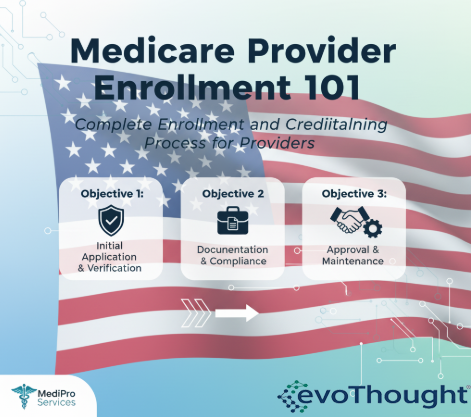
Enrolling as a Medicare provider is a critical first step for healthcare professionals and organizations that wish to serve Medicare beneficiaries and receive reimbursement for covered services. The Centers for Medicare & Medicaid Services (CMS) has developed specific processes and requirements to ensure that providers meet compliance standards. Understanding the complete enrollment and credentialing process is key to avoiding delays, denials, or compliance issues.
This guide covers everything you need to know about Medicare provider enrollment, including CMS connections, credentialing requirements, application types, form updates, revalidation processes, PECOS navigation, and payer-specific rules.
1. Overview of CMS Connection: Staying Compliant and Completing Medicare Applications
CMS oversees the Medicare program and requires all providers and suppliers to enroll before submitting claims. Proper enrollment ensures that providers:
- Meet CMS’s quality and compliance standards.
- Are correctly identified for billing and payment purposes.
- Maintain current information with Medicare Administrative Contractors (MACs).
Key systems and tools include:
- PECOS (Provider Enrollment, Chain, and Ownership System): CMS’s secure, web-based platform for electronic enrollment and updates.
- NPPES (National Plan and Provider Enumeration System): For obtaining and maintaining a National Provider Identifier (NPI).
- MACs: Regional contractors that process enrollment applications and claims.
Staying connected to CMS through these platforms is essential to keep enrollment active and compliant.
2. Medicare Credentialing Requirements
Credentialing is the process of verifying a provider’s qualifications to ensure they meet Medicare standards. Requirements typically include:
- NPI Registration: Providers must have a valid NPI before enrolling in Medicare.
- Licensure and Certification: Active state licenses and certifications must be verified.
- Background Checks: Includes ownership disclosure, adverse actions, and financial integrity.
- Accreditation (if applicable): Certain facilities, like DMEPOS suppliers, must meet accreditation standards.
- Provider-Specific Requirements: For example, physician credentials, clinical privileges, and compliance with federal regulations.
Proper credentialing ensures providers are eligible to render and bill for covered services.
3. Understanding Part A Facility Applications
Medicare Part A primarily covers inpatient services provided by hospitals, skilled nursing facilities (SNFs), hospices, and home health agencies. Part A enrollment includes:
- CMS-855A Form: Used by facilities like hospitals, SNFs, home health agencies, hospices, and other institutional providers.
- Key Requirements: Demonstration of facility compliance with Medicare Conditions of Participation, ownership disclosures, and staff qualifications.
- Common Challenges: Addressing change of ownership, mergers, or relocations that require updates to enrollment.
4. Understanding Part B Organization and Individual Applications
Part B covers outpatient services rendered by physicians, non-physician practitioners (NPPs), and supplier groups.
- CMS-855B Form: For organizations like group practices, clinics, and some supplier types (e.g., ambulance services).
- CMS-855I Form: For individual physicians and NPPs enrolling as Medicare providers.
- Key Requirements: Proof of licensure, certifications, clinical privileges, and reassignment information if billing through an organization.
- Common Pitfalls: Not updating practice locations or group affiliations, leading to claims denials.
5. Understanding Reassignment Applications
Reassignment allows individual providers to assign their right to bill Medicare to another entity, such as a group practice.
- CMS-855R Form: Used to establish or terminate a reassignment of benefits.
- Key Considerations:
- Providers must maintain a personal NPI and be enrolled in Medicare.
- The organization receiving the reassignment must be enrolled and in good standing.
- Reassignment agreements must comply with CMS requirements and be updated promptly upon changes.
6. Reviewing the Medicare Enrollment Process through CMS-855 Forms
Medicare enrollment is managed primarily through these forms:
- CMS-855A: Institutional providers (Part A).
- CMS-855B: Group practices and certain suppliers.
- CMS-855I: Individual practitioners (Part B).
- CMS-855R: Reassignment of benefits.
- CMS-855O: For physicians and NPPs who order or certify items or services but do not bill Medicare directly.
- CMS-20134: For Durable Medical Equipment, Prosthetics, Orthotics, and Supplies (DMEPOS).
Understanding which form to use — and when — ensures compliance and timely application processing.
7. Addressing Changes to CMS-855 Forms and Interpretations
CMS periodically updates the CMS-855 forms to reflect regulatory and policy changes. Recent updates may include:
- Enhanced ownership and control disclosure requirements.
- Revised screening procedures for high-risk provider types.
- Changes in reporting timelines for practice location or ownership updates.
Providers must stay current with these changes to avoid application rejections or compliance penalties.
8. The Revalidation Process for CMS-855 Forms
Revalidation is CMS’s way of ensuring that provider and supplier enrollment records are accurate and up to date.
- Frequency: Typically every 5 years (every 3 years for DMEPOS suppliers).
- Notification: CMS sends revalidation requests; however, providers should monitor their PECOS account and MAC websites proactively.
- Requirements: Verification of all enrollment information, including practice locations, ownership, and reassignment arrangements.
Timely revalidation is crucial to prevent deactivation of Medicare billing privileges.
9. Reviewing Each Section of the Application within PECOS
PECOS simplifies the enrollment process by guiding users through each section of the application, including:
- Provider/Supplier Identification: Basic demographic and NPI details.
- Practice Locations: Physical addresses and related information.
- Ownership/Managing Control: Disclosure of all controlling interests.
- Reassignment of Benefits: Linking individual practitioners to organizations.
- Supporting Documentation: Licenses, certifications, and other required documents.
Familiarity with PECOS navigation reduces errors and accelerates approval times.
10. Understanding Payer-Specific Rules for Government and Commercial Payers
While Medicare enrollment is a federal process, providers often need to credential with commercial payers as well. Each payer may have its own:
- Enrollment timelines and documentation requirements.
- Recredentialing schedules.
- Compliance and quality reporting expectations.
Best practices include maintaining a centralized credentialing file and regularly updating information for both government and commercial payers.
Conclusion
Medicare provider enrollment and credentialing are foundational steps to participate in the program and receive reimbursement. By understanding the CMS connection, credentialing requirements, application types, revalidation processes, and payer-specific rules, providers can streamline enrollment, remain compliant, and avoid disruptions in reimbursement.
Leveraging tools like PECOS, staying updated on CMS-855 form changes, and proactively managing revalidation cycles are essential strategies for smooth and successful participation in Medicare and other payer programs.