
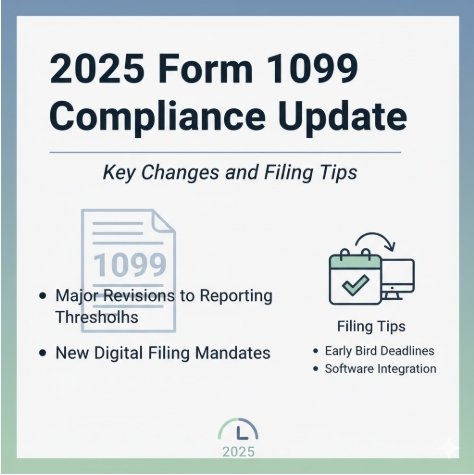
Staying compliant with the IRS’s Form 1099 reporting requirements is more critical than ever in 2025. Recent legislative changes—most notably from the One Big Beautiful Bill (OBBB)—have introduced new reporting obligations and tightened penalties for non-compliance.
This guide explains the latest 1099 updates, highlights specific form changes, and provides practical filing tips to help businesses and tax professionals remain compliant.
1. The One Big Beautiful Bill (OBBB) and Its New 1099 Requirements
The OBBB, passed in late 2024, aims to streamline tax reporting and close gaps in third-party payment reporting. Key 1099-related provisions include:
- Expanded Third-Party Reporting: Lower thresholds for reporting transactions via payment processors (affecting Form 1099-K).
- New Digital Asset Reporting Rules: Strengthened requirements for exchanges and brokers using Form 1099-DA.
- Unified Filing Framework: Encourages more consistent e-filing and cross-form reporting.
- Increased Penalties: For late or incorrect filings, especially for businesses with a history of non-compliance.
These changes mean businesses must audit their payment processes and update accounting systems to capture all reportable transactions.
2. Updates to Major 1099 Forms in 2025
a) Form 1099-NEC (Non-Employee Compensation)
- Continues to be used for reporting payments of $600 or more to independent contractors, freelancers, and certain professionals.
- Reminder: Payments for attorney’s fees for legal services provided directly to a business (not as part of a settlement) must be reported on Form 1099-NEC.
b) Form 1099-MISC (Miscellaneous Information)
- Remains in use for rents, royalties, prizes, and other miscellaneous payments.
- Attorney’s fees paid as part of a settlement or to a law firm’s trust account are reported on Form 1099-MISC, not NEC.
- New checkbox added to indicate settlement-related payments in line with OBBB reporting alignment.
c) Form 1099-K (Payment Card and Third-Party Network Transactions)
- The threshold for reporting remains lowered at $5,000 in aggregate payments (under OBBB) with any number of transactions.
- Marketplaces, gig-platforms, and payment apps must ensure compliance by providing accurate 1099-K forms to payees.
- The IRS has clarified reporting requirements for split payments and refund adjustments.
d) Form 1099-DA (Digital Asset Reporting)
- Newly mandatory in 2025 for brokers and platforms facilitating digital asset (e.g., cryptocurrency, tokenized securities) transactions.
- Requires reporting of gross proceeds, acquisition dates, cost basis, and wallet transfer details.
- Aimed at increasing transparency for taxpayers trading in digital assets.
e) Other 1099 Forms
- Form 1099-R: No major changes but expect increased scrutiny on retirement distribution reporting.
- Form 1099-INT & 1099-DIV: Remain largely unchanged, though alignment with OBBB’s e-filing requirements applies.
3. Key Reminders for 2025 Filings
Due Dates
- Form 1099-NEC: January 31, 2025 (to recipients and IRS)
- Form 1099-MISC, 1099-K, 1099-DA: Due to recipients by January 31, 2025, and to the IRS by February 28, 2025 (paper) or March 31, 2025 (e-file)
E-Filing
- Mandatory for businesses issuing 10 or more forms (combined across all information returns).
- IRS’s FIRE system and new IRIS platform can be used for electronic submissions.
TIN Online Matching
- Businesses should use the IRS TIN Matching Program to verify payees’ names and taxpayer identification numbers before issuing forms.
- Reduces the risk of mismatched records and associated penalties.
FIT Withholding Requirements
- Payments subject to backup withholding (24%) must be reported accurately, especially for contractors who fail to provide a valid TIN.
- Ensure accounting systems track withholding separately.
4. Special Situations
Attorney’s Fees
- 1099-NEC: When attorneys are paid directly for legal services performed for your business.
- 1099-MISC: When reporting payments related to settlements or damages, particularly when the payment is made to a law firm or trust account.
Payments to the Estate of a Deceased Employee
- Wages earned before death: Report on Form W-2 (for the year of death).
- Subsequent payments made to the estate after the employee’s death are reportable on Form 1099-MISC.
5. Penalties for Non-Compliance
Non-compliance in 2025 carries stiffer penalties under the OBBB framework:
- Late filing: $60–$310 per form depending on how late, with a maximum annual cap.
- Intentional disregard: Minimum $630 per form with no annual cap.
- Incorrect information (e.g., invalid TIN): Same penalty schedule as above.
- Failure to e-file when required: Additional $310 per form.
6. Best Practices for Compliance
- 🔎 Audit vendor records early to identify missing or invalid TINs.
- 📥 Collect and store W-9 forms before making payments.
- 📅 Set calendar reminders for due dates and test your e-filing process in advance.
- 💻 Adopt software that integrates 1099 reporting with your accounting system.
- ✅ Use the IRS TIN Matching Program regularly.
- 📚 Train staff on classifying payments correctly across NEC, MISC, K, and DA forms.
- 🔐 Maintain secure records for at least four years in case of audits.
7. Frequently Asked Questions
Q: Do I need to issue both a 1099-NEC and a 1099-K for the same contractor?
A: No. If payments are made entirely through a third-party platform that issues a 1099-K, you typically do not issue a 1099-NEC.
Q: What if I discover errors after filing?
A: File a corrected 1099 form as soon as possible to minimize penalties.
Q: Are reimbursements for expenses to contractors reportable?
A: Only if they’re not backed by proper documentation or are included in the contractor’s fee.
Q: Do digital asset transfers between personal wallets trigger 1099-DA reporting?
A: No, reporting applies to sales and broker-facilitated transfers, not peer-to-peer wallet moves.
Conclusion
The 2025 compliance landscape for Form 1099 reporting is more complex but also clearer thanks to the OBBB. By understanding the new rules, deadlines, and reporting specifics, businesses can avoid penalties and streamline their year-end reporting.
Proactive preparation—especially for e-filing, TIN matching, and new digital asset reporting—will ensure a smooth filing season.