
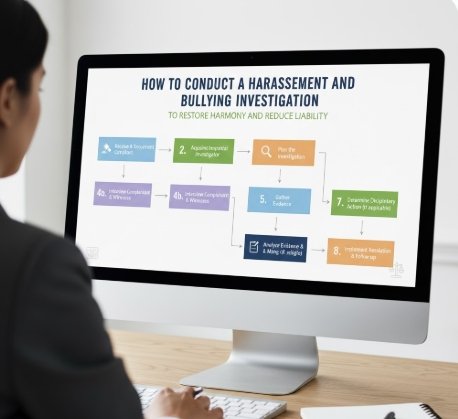
Workplace harassment and bullying complaints, if not handled correctly, can damage employee trust, disrupt productivity, and expose organizations to significant legal risk. A well-structured, impartial investigation is essential not only to resolve the issue fairly but also to restore workplace harmony and minimize liability.
This article outlines a practical, step-by-step approach to conducting an effective harassment and bullying investigation, from intake to final conclusions.
Steps of a Harassment and Bullying Investigation
A consistent investigation process ensures fairness, transparency, and legal defensibility. The key steps include:
- Receive and Acknowledge the Complaint
Acknowledge the complaint promptly and reassure the complainant that the matter will be handled seriously and confidentially. - Assess Immediate Risk
Determine whether interim measures are needed, such as schedule changes or temporary separation, to prevent further harm or retaliation. - Plan the Investigation
Define the scope, identify relevant policies, and determine who will conduct the investigation. - Collect Evidence
Gather documents, electronic records, policies, and any prior complaints related to the matter. - Conduct Interviews
Interview the complainant, accused, and relevant witnesses in a fair and structured manner. - Analyze Information and Determine Credibility
Review all evidence objectively and assess the credibility of each interviewee. - Draw Conclusions
Decide whether the allegations are substantiated, unsubstantiated, or inconclusive based on evidence. - Implement Corrective Action
Take appropriate remedial action if policy violations are found. - Close the Investigation
Communicate the outcome to relevant parties and document all actions taken.
Key Components of an Investigation
An effective harassment and bullying investigation includes several critical components:
- Impartial Investigator – Someone trained and unbiased, with no conflict of interest
- Clear Scope and Timeline – Defined issues, timeframe, and expected completion
- Relevant Policies and Laws – Company policies and applicable employment laws
- Evidence Collection – Documents, emails, messages, CCTV footage, and witness statements
- Confidentiality and Non-Retaliation – Clear expectations communicated to all parties
These components help ensure the investigation withstands legal and regulatory scrutiny.
Informal vs. Formal Resolution of Complaints
Understanding the difference between informal and formal resolution helps determine the appropriate response.
Informal Resolution
- Suitable for minor, first-time issues
- May include mediation, coaching, or facilitated discussions
- Does not involve a full fact-finding investigation
- Requires agreement from both parties
Formal Resolution
- Required for serious, repeated, or high-risk allegations
- Involves a documented, structured investigation
- May lead to disciplinary action
- Provides stronger legal protection for the organization
Not all complaints are appropriate for informal resolution, especially those involving threats, discrimination, or power imbalances.
Sample Interview Questions
Questions for the Complainant
- Can you describe what happened, including dates and locations?
- How did the behavior affect you or your work?
- Were there any witnesses to the incidents?
- Have you previously reported this issue?
- What outcome are you seeking?
Questions for the Accused
- Are you aware of the complaint made against you?
- How do you respond to the allegations?
- Were there any interactions with the complainant during the time in question?
- Can you identify witnesses or evidence that supports your account?
- Is there anything else you would like to add?
Questions for Witnesses
- What did you observe or hear related to this situation?
- When and where did this occur?
- Did you notice any patterns of behavior?
- Did anyone discuss the incident with you afterward?
- Is there any relevant information you believe is important?
Documentation Requirements
Proper documentation is essential to demonstrate fairness and due diligence.
Key records include:
- Initial complaint and acknowledgment
- Investigation plan and scope
- Interview notes and signed statements
- Copies of relevant policies
- Evidence collected (emails, messages, logs)
- Findings and conclusions report
- Corrective actions taken
All records should be stored securely and retained according to legal and organizational requirements.
Determining Credibility of Each Interviewee
Credibility assessments should be objective and evidence-based, not based on personality or position.
Factors to consider include:
- Consistency of the interviewee’s account
- Corroboration by documents or witnesses
- Plausibility and detail of statements
- Motive to exaggerate or misrepresent facts
- Past behavior or similar complaints (when legally permissible)
Credibility determinations must be clearly explained in the final investigation report.
Drawing Conclusions
After reviewing all evidence, the investigator must determine whether the allegations are:
- Substantiated – Evidence supports the claim
- Unsubstantiated – Insufficient evidence to support the claim
- Inconclusive – Conflicting evidence prevents a definitive finding
Conclusions should be based on a preponderance of evidence standard—whether it is more likely than not that the behavior occurred.
Conclusion
A well-executed harassment and bullying investigation protects employees, reinforces organizational values, and reduces legal exposure. By following a structured process, maintaining thorough documentation, and ensuring impartiality, organizations can resolve complaints fairly while restoring trust and workplace harmony.
Effective investigations are not just about compliance—they are about creating a respectful, safe, and accountable work environment.