
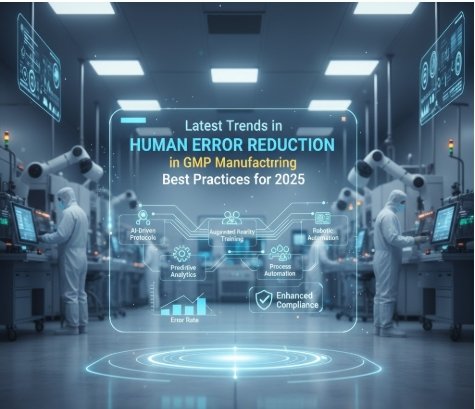
In the world of Good Manufacturing Practice (GMP), one principle remains constant—human error is inevitable, but preventable. As global industries evolve toward automation and data-driven quality systems, managing human error has become a strategic priority for pharmaceutical, biotech, and medical device manufacturers.
Regulatory bodies such as the FDA, EMA, and ICH continue to tighten compliance expectations, urging manufacturers to adopt proactive methods for identifying and mitigating human error. The days of simply blaming individuals are gone—2025 marks a shift toward systemic prevention, human performance improvement, and AI-enabled error reduction.
This article explores the latest innovations, psychological insights, and digital tools transforming how GMP-regulated companies prevent, detect, and learn from human errors.
1. The Psychology Behind Modern Human Error
Human error is rarely the result of negligence—it’s often a symptom of systemic weaknesses. Modern psychology identifies multiple contributors:
- Cognitive overload – Excessive documentation, multitasking, and alert fatigue lead to attention lapses.
- Environmental distractions – Poor lighting, noise, or workspace layout can disrupt focus.
- Procedural complexity – Overly detailed SOPs create confusion and variability.
- Training fatigue – Repetitive, non-interactive training fails to build retention or awareness.
To counter these, organizations are adopting Human Performance Improvement (HPI) frameworks that treat human error as data—a source of insight rather than blame. These frameworks analyze behavior patterns, process design, and human factors holistically.
2. Modern Misconceptions: Human Error as a Root Cause
A major shift in 2025’s GMP landscape is the rejection of “human error” as a final root cause.
Instead of writing “operator error” on a deviation report, modern quality systems demand a systemic investigation—why the operator made the error and what environmental or procedural factors contributed.
For example:
- Was the instruction unclear?
- Was the system designed to catch the error before it happened?
- Was fatigue or workflow pressure a factor?
By asking these deeper questions, manufacturers are uncovering systemic vulnerabilities—and designing preventive controls that truly work.
3. Aligning with FDA, EU, and ICH Compliance Standards
Global regulators are now explicitly emphasizing human error reduction in their quality expectations.
The FDA’s guidance on Quality Management Maturity (QMM) and ICH Q10 highlight the importance of process design, performance monitoring, and CAPA effectiveness.
In 2025, compliance leaders must ensure:
- Documented RCA for all human-error-related deviations.
- Risk-based CAPA implementation, prioritized by potential patient impact.
- Continuous monitoring of the Human Error Rate (HER) as a key performance indicator.
- Integration of human performance training into GMP onboarding and retraining programs.
Companies aligning with these expectations not only reduce compliance risk but also gain recognition for operational maturity.
4. Advanced Root Cause Analysis (RCA): Going Beyond the Surface
Traditional Root Cause Analysis methods like the “5 Whys” or fishbone diagrams remain useful—but are now being enhanced by digital RCA platforms that capture data, identify trends, and link causes across departments.
The Modern RCA Toolkit
- Root Cause Determination Tool (RCDT): Uses structured logic trees to distinguish between behavioral, systemic, and environmental causes.
- Cognitive RCA Models: Incorporate human factors and psychology into root cause mapping.
- Data-driven RCA Software: Tracks repetitive issues and correlates them with CAPA outcomes.
These tools transform RCA from a reactive reporting task into a predictive performance management process.
5. Monitoring the Human Error Rate (HER) with Smart Metrics
The Human Error Rate (HER) has become one of the most important metrics in GMP environments.
It measures the frequency of human-error-related deviations across production, packaging, and laboratory processes.
Modern organizations use smart dashboards that:
- Track error frequency, type, and severity.
- Identify hotspots (specific lines, shifts, or operators).
- Correlate data with training records, workload, and environmental factors.
- Use predictive analytics to anticipate when and where the next error might occur.
This data transforms quality management from reactive compliance to proactive prevention.
6. Data-Driven CAPA Systems and Real-Time KPIs
CAPA (Corrective and Preventive Action) systems have evolved dramatically. In 2025, organizations are using AI-enhanced CAPA systems that not only document deviations but continuously learn from them.
Key CAPA Innovations:
- Automated CAPA tracking: AI recommends corrective actions based on historical success rates.
- KPI dashboards: Real-time CAPA effectiveness metrics visualize whether implemented solutions truly reduce recurrence.
- Cross-functional linkage: CAPA data now connects with HR, training, and safety systems to identify broader patterns.
These systems close the loop between error detection, investigation, and organizational learning.
7. The Rise of AI and Predictive Analytics in Error Prevention
Artificial Intelligence (AI) and machine learning are driving the next evolution of GMP quality systems.
Manufacturers are leveraging predictive analytics to forecast human errors before they occur.
Examples of AI in GMP Error Reduction:
- Pattern recognition: AI identifies patterns in deviation data that humans might overlook.
- Predictive alerts: Algorithms warn when conditions match previous high-error scenarios.
- Natural language models (e.g., ChatGPT): Provide real-time procedural guidance and answer operator questions during manufacturing tasks.
- AI-based risk scoring: Rates tasks based on human interaction complexity and suggests automation where feasible.
Instead of reacting to mistakes, organizations are forecasting and preventing them—a revolutionary shift from traditional compliance models.
8. AI-Powered Training and Decision Support
Training is no longer a one-size-fits-all PowerPoint session.
In 2025, companies are adopting AI-powered learning platforms that adapt content to each employee’s learning pace and track performance metrics over time.
New Training Approaches:
- Simulation-based learning: Realistic GMP scenarios allow employees to practice critical decisions safely.
- ChatGPT-integrated training assistants: Employees can interact with virtual mentors to clarify SOPs instantly.
- Adaptive learning modules: AI monitors quiz data to adjust difficulty and content focus.
These systems ensure that training is not just completed—but internalized.
9. Workplace Design and Human Factors Engineering
Physical and digital workplace design plays a crucial role in minimizing human error.
Manufacturers are applying Human Factors Engineering (HFE) principles to create intuitive, error-tolerant environments.
Trends in 2025:
- Digital SOP integration: Smart tablets guide operators step-by-step with visual cues.
- Ergonomic workstations: Reduce strain, fatigue, and repetitive motion errors.
- Automation collaboration: Cobots (collaborative robots) assist humans in repetitive, error-prone tasks.
- Interface simplification: Clear labeling, color coding, and intuitive screens minimize confusion.
The result? A safer, more efficient workspace where human performance is supported by design.
10. Predictive Metrics: Trending, Monitoring, and Forecasting Errors
Predictive analytics is transforming error management from retrospective analysis to forward-looking prevention.
By collecting large volumes of data across production lines, AI systems can forecast risk levels and recommend preventive actions.
How Predictive Metrics Work:
- Data collection: HER, CAPA outcomes, and deviation reports are centralized.
- Trend analysis: AI models identify recurring error categories.
- Forecast generation: Predictive dashboards visualize potential risks for upcoming production runs.
- Proactive interventions: Supervisors can schedule retraining or revalidation before an error occurs.
This continuous feedback loop enables smarter, faster decision-making and reduces deviation costs significantly.
11. Current Statistics and Industry Insights
Recent studies reveal how impactful these strategies have become:
- Companies implementing AI-assisted RCA tools have reduced human error deviations by up to 38% within the first year.
- Predictive analytics can identify potential error spikes with up to 80% accuracy.
- Organizations that track HER monthly report 25% faster CAPA closure rates.
- Firms investing in AI-based training see a 40% improvement in knowledge retention compared to traditional classroom methods.
These metrics demonstrate that digital transformation in GMP isn’t just a trend—it’s a measurable improvement in compliance and efficiency.
12. The Future: A Data-Driven, Human-Centered GMP Culture
As we move deeper into 2025 and beyond, human error management will no longer be viewed as a compliance checkbox—it will be an integral component of organizational excellence.
Future-ready GMP manufacturers will:
- Foster psychological safety, encouraging staff to report near misses without fear.
- Build AI-assisted quality ecosystems that blend technology with human insight.
- Continuously refine metrics, analytics, and RCA tools for sustained learning.
- Create a culture of resilience, accountability, and adaptability.
In this era, the goal is not just fewer errors—but smarter systems and empowered people who can prevent them.
Conclusion
The latest trends in human error reduction in GMP manufacturing show a decisive move from reactive problem-solving to proactive prevention.
By combining human factors science, AI, predictive analytics, and data-driven CAPA systems, manufacturers are building operations that are both compliant and resilient.
The organizations that embrace these innovations today will lead the way in compliance excellence, product safety, and workforce performance tomorrow.